From the notebook
CDD vs EDD: risk-based customer due diligence, with a risk-scoring model in Python
Customer due diligence (CDD) is the standard KYC check; enhanced due diligence (EDD) adds source of funds, senior approval and closer monitoring for higher-risk customers; simplified due diligence (SDD) does less for low risk. How a risk score decides which applies, why foreign PEPs and sanctions hits override the score, and tested Python.
CDD (customer due diligence) is the standard set of KYC checks: verify the customer’s identity, screen them against sanctions and PEP lists, and record the purpose of the relationship and the activity you expect. EDD (enhanced due diligence) is what you add for higher-risk customers: documented source of funds and wealth, senior management approval, more frequent reviews and tighter monitoring. SDD (simplified due diligence) allows lighter checks where risk is demonstrably low. Which one applies is decided by a risk assessment, usually a score built from country, product, channel and customer factors. Two things override the score: a confirmed sanctions match stops onboarding, and a foreign politically exposed person (PEP) always gets EDD under FATF Recommendation 12. Below is a tested Python model of that decision.
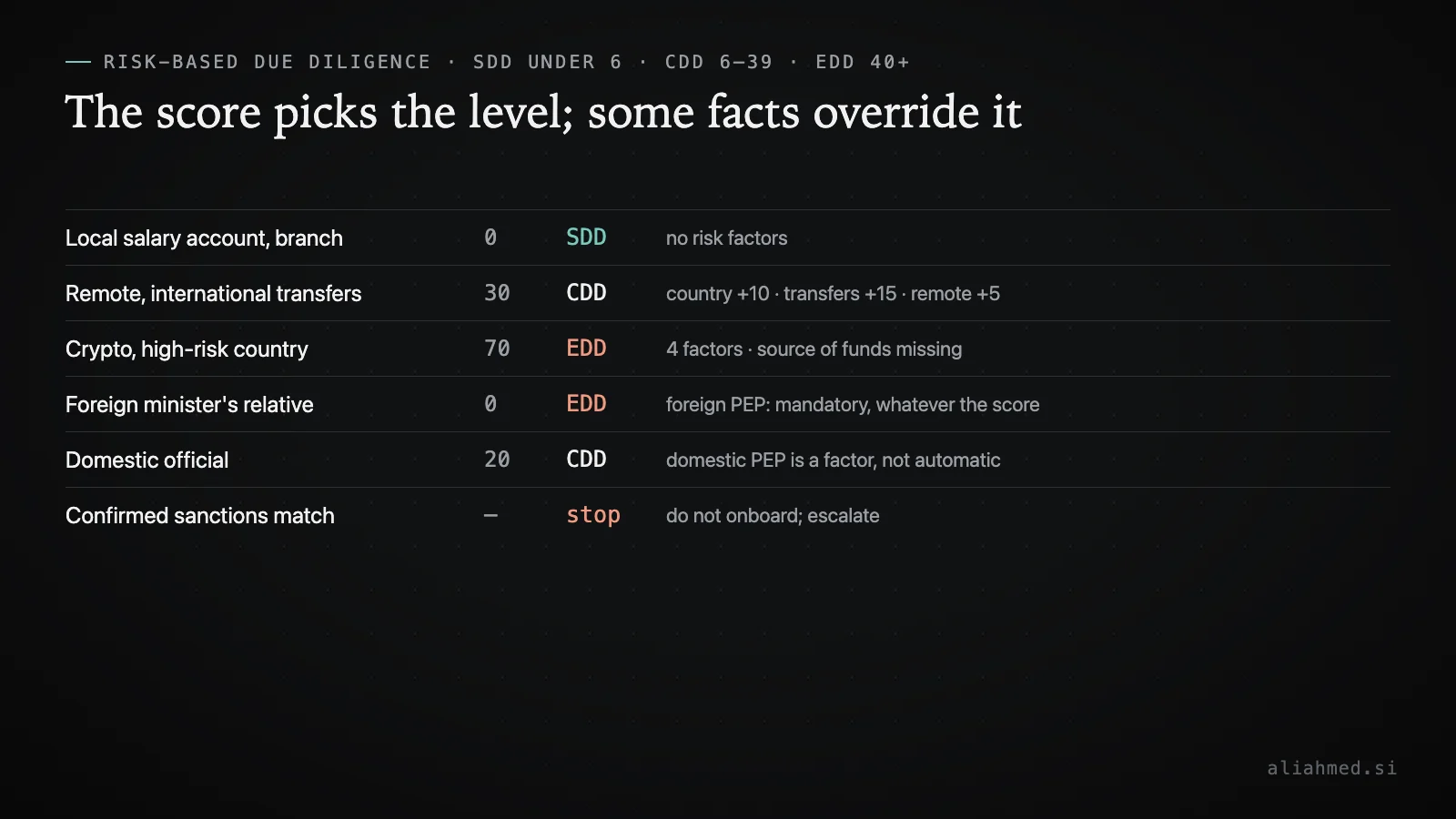
The five test customers and the level each one gets.
CDD, EDD and SDD side by side
| Level | When | What it adds |
|---|---|---|
| SDD | Demonstrably low risk, where rules allow it | Identity verification and sanctions screening, with less frequent review |
| CDD | The default | Identity, sanctions and PEP screening, purpose and expected activity, periodic review |
| EDD | High risk, or a mandatory trigger | Source of funds and wealth, senior approval, more frequent review, tighter monitoring thresholds |
All three are part of KYC, which is in turn one part of an AML programme; see KYC vs AML vs KYB vs CDD and AML vs KYC in practice.
A risk-scoring model
from dataclasses import dataclass

# Example weights. A real model comes from the business's own risk assessment and its regulator's guidance.
COUNTRY_RISK = {"high": 30, "medium": 10, "low": 0}
PRODUCT_RISK = {"crypto_withdrawals": 20, "international_transfers": 15, "salary_account": 0}
CHANNEL_RISK = {"remote_unverified_device": 10, "remote": 5, "branch": 0}

@dataclass
class Customer:
    name: str
    country_risk: str
    products: list[str]
    channel: str
    pep: str | None = None  # None, "domestic" or "foreign"
    sanctions_hit: bool = False
    adverse_media: bool = False
    expected_monthly: float = 0.0
    source_of_funds_documented: bool = False

def risk_score(c: Customer) -> tuple[int, list[str]]:
    score, reasons = 0, []
    def add(points, why):
        nonlocal score
        if points:
            score += points
            reasons.append(f"+{points} {why}")
    add(COUNTRY_RISK[c.country_risk], f"{c.country_risk}-risk country")
    for p in c.products:
        add(PRODUCT_RISK.get(p, 0), p.replace("_", " "))
    add(CHANNEL_RISK[c.channel], c.channel.replace("_", " "))
    add(25 if c.adverse_media else 0, "adverse media")
    add(20 if c.pep == "domestic" else 0, "domestic PEP")
    add(10 if c.expected_monthly > 50_000 else 0, "high expected volume")
    return score, reasons
Every point comes with a reason. That’s the most important design choice in the model: an auditor or a reviewer needs to see why a customer was rated high, not just the number.
Deciding the level
def due_diligence(c: Customer) -> dict:
    """Decide the level of due diligence. Some triggers override the score entirely."""
    if c.sanctions_hit:
        return {"level": "stop", "why": ["confirmed sanctions match: do not onboard, escalate"]}
    score, reasons = risk_score(c)
    if c.pep == "foreign":
        reasons = ["foreign PEP: enhanced due diligence is mandatory regardless of score"] + reasons
        level = "EDD"
    elif score >= 40:
        level = "EDD"
    elif score <= 5:
        level = "SDD"
    else:
        level = "CDD"
    actions = {
        "SDD": ["verify identity", "screen sanctions"],
        "CDD": ["verify identity", "screen sanctions and PEPs", "record purpose and expected activity", "review every 2 years"],
        "EDD": ["everything in CDD", "document source of funds and wealth", "senior management approval",
                "review every year", "tighter monitoring thresholds"],
    }[level]
    missing = ["source of funds"] if level == "EDD" and not c.source_of_funds_documented else []
    return {"level": level, "score": score, "why": reasons, "actions": actions, "missing": missing}
The test runs six customers through it:
| Customer | Score | Level | Why |
|---|---|---|---|
| Local salary account, branch | 0 | SDD | No risk factors |
| Remote, international transfers | 30 | CDD | Medium-risk country, transfers, remote |
| Crypto, high-risk country | 70 | EDD | Four factors; source of funds still missing |
| Foreign minister’s relative | 0 | EDD | Foreign PEP: mandatory, whatever the score |
| Domestic official | 20 | CDD | Domestic PEP is a risk factor, not an automatic EDD |
| Confirmed sanctions match | none | stop | Don’t onboard; escalate |
Two results show why the overrides exist. The foreign PEP scores 0 on every other factor, and a pure score would have put them on simplified checks. And the distinction between foreign and domestic PEPs matters: FATF requires enhanced measures for foreign PEPs in all cases, but for domestic PEPs only when the relationship is higher risk, so treating every PEP as automatic EDD over-burdens low-risk customers without being required.
Making it real
- Calibrate the weights. The numbers above are illustrative. A real model is set by the business’s documented risk assessment, checked against its regulator’s guidance, and tested on past cases: did the customers who later caused problems score high?
- Feed it good inputs. PEP and sanctions flags come from name screening, and for businesses from tracing beneficial owners. A wrong input gives a confident wrong level.
- Re-score on change. A new product, a move to a high-risk country or new adverse media should trigger a fresh assessment, not wait for the periodic review.
- Keep the reasons. Store the score, the reasons and the version of the model with the case, for as long as records must be kept; see KYC data retention.
Summary
- CDD is the standard check; EDD adds source of funds, senior approval and closer monitoring; SDD is lighter where risk is low.
- A risk score from country, product, channel and customer factors picks the level, and each point carries a reason.
- Overrides beat the score: a sanctions match stops onboarding; a foreign PEP always gets EDD; a domestic PEP is a risk factor.
- Calibrate weights on real cases, re-score when facts change, and keep the reasons.
For the full verification flow these checks sit in, see how KYC identity verification works.
Part of the guide KYC and identity verification engineering, which puts related articles in reading order.