From the notebook
KYB vs KYC: verifying a business and finding its real owners, with a beneficial-ownership calculation in Python
KYC verifies a person; KYB verifies a business and the people behind it. How KYB works, why the 25% beneficial-ownership threshold means different things in the US and the UK and EU, and tested Python that multiplies stakes through holding companies to find owners the share register hides.
KYC verifies a person: that they exist, are who they say, and aren’t on a sanctions list. KYB (know your business) verifies a company: that it’s legally registered and active, who its directors are, and above all who its ultimate beneficial owners (UBOs) are, the natural persons who own or control it, often through other companies. Each UBO then goes through KYC. The hard part is ownership through chains: someone who holds 15% directly can effectively own 36% through two holding companies, as in the tested example below. Thresholds also differ: the US counts owners of 25% or more, the UK and EU more than 25%, so a person at exactly 25% is a beneficial owner in one regime and not the other.
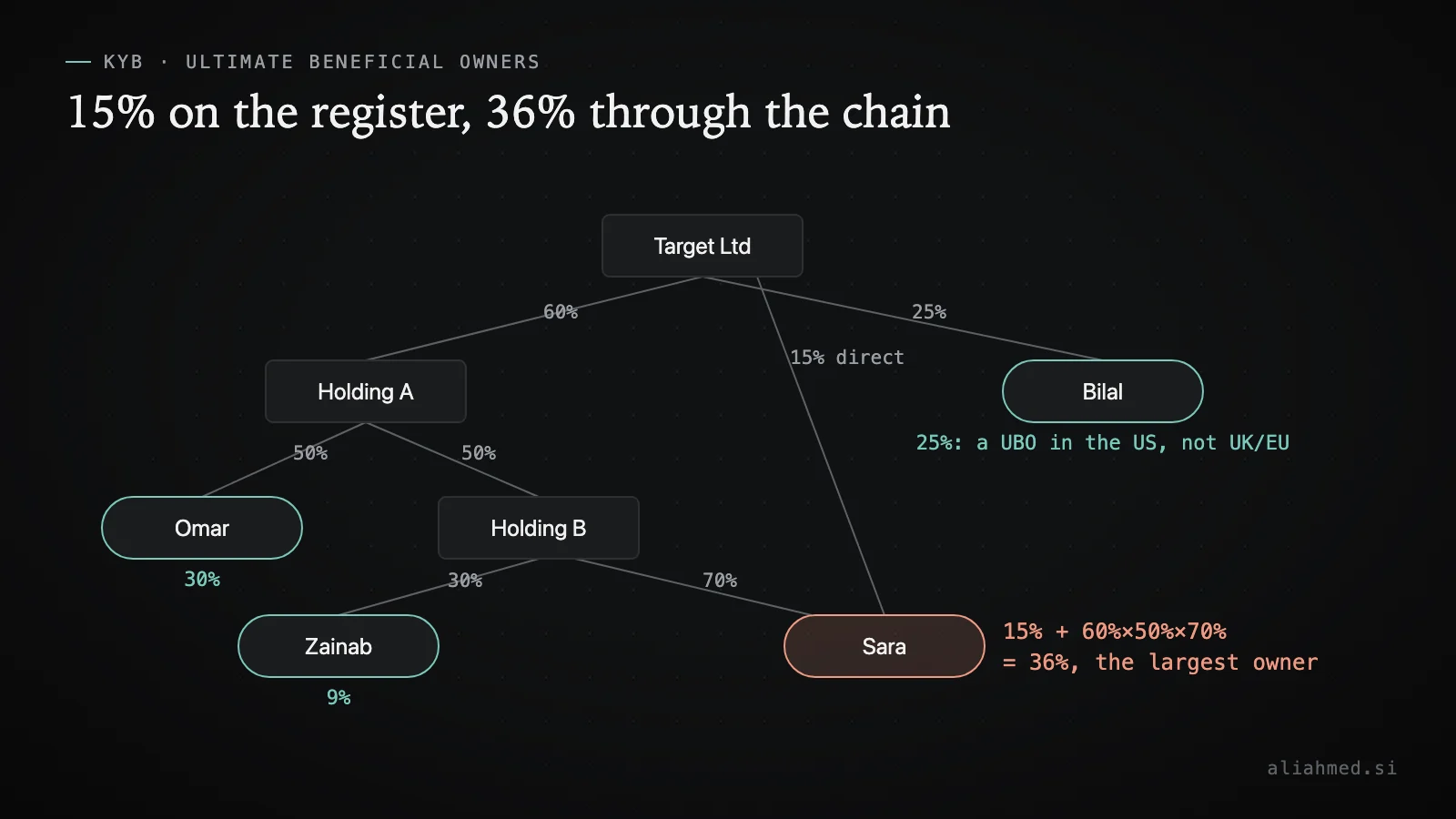
Sara holds 15% on the register, and 36% once the chain through two holding companies is multiplied out.
What does KYB check?
- The company exists: registration number, legal name and status from the official registry.
- Who runs it: directors and officers, each verified like any individual.
- Who owns it: the shareholder structure, traced through holding companies until only natural persons remain.
- Who controls it: people with control without ownership, such as a CEO or someone holding voting rights.
- Risk: industry, countries involved, sanctions and adverse media on the company and its people.
KYB is part of the same AML programme as KYC; see AML vs KYC and KYC vs AML vs KYB vs CDD.
Calculating effective ownership
Multiply stakes along every chain from the company to each person, and add the chains together:
from collections import defaultdict

def effective_ownership(company: str, shareholders: dict[str, list[tuple[str, float]]]) -> dict[str, float]:
    """Each person's total effective stake in `company`. shareholders maps an entity to its direct owners:
    [(owner, fraction), ...]. Entities with no entry are treated as natural persons."""
    totals: dict[str, float] = defaultdict(float)

    def walk(entity: str, share: float, path: tuple[str, ...]):
        if entity in path:
            raise ValueError(f"circular ownership: {' -> '.join(path + (entity,))}")
        owners = shareholders.get(entity)
        if not owners:
            totals[entity] += share
            return
        for owner, fraction in owners:
            walk(owner, share * fraction, path + (entity,))

    for owner, fraction in shareholders[company]:
        walk(owner, fraction, (company,))
    return dict(totals)

def beneficial_owners(company, shareholders, threshold=0.25, inclusive=True):
    """inclusive=True: '25% or more' (the US CDD rule). inclusive=False: 'more than 25%' (UK and EU)."""
    stakes = effective_ownership(company, shareholders)
    hit = (lambda s: round(s, 9) >= threshold) if inclusive else (lambda s: round(s, 9) > threshold)
    return sorted(((p, round(s, 4)) for p, s in stakes.items() if hit(s)), key=lambda x: -x[1])
For the structure in the figure:
structure = {
    "Target Ltd": [("Holding A", 0.60), ("Sara", 0.15), ("Bilal", 0.25)],
    "Holding A": [("Omar", 0.50), ("Holding B", 0.50)],
    "Holding B": [("Sara", 0.70), ("Zainab", 0.30)],
}
effective_ownership("Target Ltd", structure)
# {'Omar': 0.3, 'Sara': 0.36, 'Zainab': 0.09, 'Bilal': 0.25}
beneficial_owners("Target Ltd", structure)                   # US: [('Sara', 0.36), ('Omar', 0.3), ('Bilal', 0.25)]
beneficial_owners("Target Ltd", structure, inclusive=False)  # UK/EU: [('Sara', 0.36), ('Omar', 0.3)]
The tests check that the stakes add up to 100%, that both threshold rules give the results above, and that circular ownership (company X owns Y, which owns X) raises an error instead of looping forever. Circular structures exist in practice and are themselves a reason for a human to look closer.
Where it gets harder
- Rounding at exactly the threshold. Floating-point arithmetic can land a hair off the intended value (in Python,
0.35 + 0.1is0.44999999999999996), which is why the comparison rounds first. A person meant to hold exactly 25% shouldn’t fall out of the list through arithmetic. For legal records, store stakes as exact fractions or basis points instead. - Control, not just ownership. Voting agreements, trusts and nominee shareholders can give control without a large stake. If no one meets the ownership threshold, regulations generally require identifying who controls the company, such as a senior manager.
- Data quality. Registries differ in what they publish and how current it is; documents from the company (share registers, trust deeds) fill the gaps, and then need document checks of their own.
- Screening every person found. Each UBO and director goes through sanctions name screening, including the transliteration problems of names from different scripts.
Summary
- KYC verifies people; KYB verifies a company, its directors and its ultimate beneficial owners.
- Effective ownership multiplies along chains and adds across them: a 15% shareholder can own 36%.
- Thresholds differ: 25% or more (US) vs more than 25% (UK, EU). Make the rule explicit in code.
- Detect circular ownership, round before comparing, and identify controllers when no one meets the threshold.
Related: AML vs KYC with a transaction-monitoring rule.
Part of the guide KYC and identity verification engineering, which puts related articles in reading order.