From the notebook
AML vs KYC: what the difference is in practice, with a structuring-detection rule in Python
KYC checks who a customer is at onboarding; AML is the whole programme against money laundering, including monitoring what customers do afterwards. The difference explained, and a tested Python transaction-monitoring rule that flags structuring: repeated cash deposits just under a reporting threshold.
KYC (know your customer) answers who the customer is: identity verification, sanctions screening and a risk rating, mostly at onboarding. AML (anti-money laundering) is the whole programme a regulated business runs to detect and report money laundering, and KYC is one part of it. The rest of AML is about what customers do after onboarding: transaction monitoring, investigating alerts, filing suspicious activity reports, keeping records and periodic re-checks. A customer can pass KYC perfectly and still launder money; transaction monitoring is how you’d notice. Below is a tested Python version of one classic monitoring rule, structuring detection, to make the difference concrete.
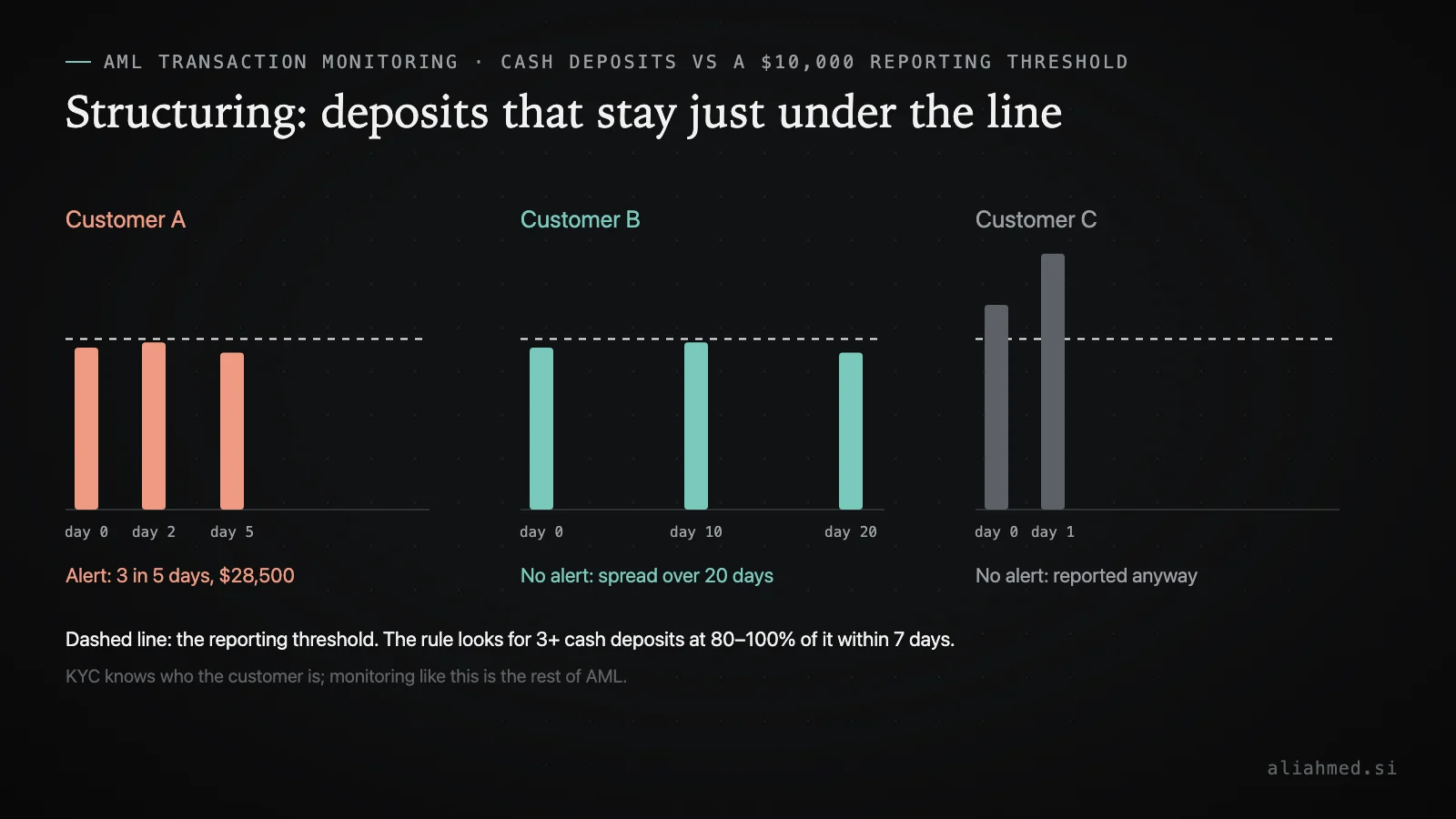
The structuring rule below flags customer A only.
KYC vs AML at a glance
| KYC | AML | |
|---|---|---|
| Question | Who is this customer, and how risky? | Is money being laundered through us, and have we reported it? |
| When | Onboarding, and periodic refreshes | Continuously, for the whole relationship |
| Main activities | ID verification, screening, risk rating, CDD | KYC plus transaction monitoring, investigations, reporting, training, record keeping |
| Typical output | Approve, reject or review a customer | Alerts, cases, suspicious activity reports |
CDD (customer due diligence) is the KYC work itself, deepened to EDD (enhanced due diligence) for higher-risk customers. KYB applies the same idea to businesses and the people who own them; see KYB vs KYC and beneficial ownership. The longer overview is in KYC vs AML vs KYB vs CDD.
A monitoring rule: structuring
Many countries require banks to report cash transactions above a threshold; in the US, cash transactions over $10,000 trigger a Currency Transaction Report. Structuring is splitting deposits to stay under that line, and in the US it is itself an offence, even when the money is legitimate. A rule to catch it:
from dataclasses import dataclass
from datetime import datetime, timedelta

@dataclass
class Deposit:
    customer: str
    amount: float
    at: datetime
    cash: bool = True

def structuring_alerts(deposits: list[Deposit], threshold: float = 10_000, window: timedelta = timedelta(days=7),
                       near: float = 0.8, min_count: int = 3) -> list[dict]:
    """Flag customers who make several cash deposits just under the reporting threshold within a rolling window,
    adding up to more than the threshold. Produces alerts for review, not verdicts."""
    alerts = []
    by_customer: dict[str, list[Deposit]] = {}
    for d in sorted(deposits, key=lambda d: d.at):
        if d.cash and near * threshold <= d.amount < threshold:
            by_customer.setdefault(d.customer, []).append(d)
    for customer, ds in by_customer.items():
        start = 0
        for end in range(len(ds)):
            while ds[end].at - ds[start].at > window:
                start += 1
            group = ds[start:end + 1]
            if len(group) >= min_count and sum(d.amount for d in group) > threshold:
                alerts.append({"customer": customer, "count": len(group), "total": sum(d.amount for d in group),
                               "from": group[0].at.date().isoformat(), "to": group[-1].at.date().isoformat()})
                break  # one alert per customer per run; the reviewer sees the full history
    return alerts
The test feeds five customers through it:
| Customer | Pattern | Alert? |
|---|---|---|
| A | $9,500, $9,800, $9,200 cash within 5 days | Yes: 3 deposits, $28,500 |
| B | The same amounts, spread over 20 days | No |
| C | $12,000 and $15,000: above the line, reported anyway | No |
| D | Three $9,900 wires, not cash | No |
| E | Small cash deposits of $2,000–3,000 | No |
Why rules alone aren’t enough
The parameters (80% of the threshold, 7 days, 3 deposits) are guesses until tuned on real alerts. Set them loose and analysts drown in false positives; set them tight and patient structurers spread deposits over a longer window, as customer B did. Production systems run many rules plus models, score alerts by risk, and record why every alert was closed, the same audit principle as in sanctions name screening.
KYC data makes monitoring better: the risk rating and expected activity captured at onboarding (“salary account, about $3,000 a month”) are what makes $28,500 in cash unusual. That’s the practical link between the two. Where AI helps, it’s in prioritising and summarising alerts for analysts, not in making the reporting decision.
Summary
- KYC = who the customer is, at onboarding and periodic refresh. AML = the whole programme, of which KYC is one part.
- AML adds transaction monitoring, investigation, reporting and record keeping.
- Structuring (splitting cash deposits under a reporting threshold) is a classic monitoring rule; the tested version flags 3+ near-threshold cash deposits within 7 days.
- Tune rules on real alerts, record closure reasons, and feed KYC risk data into monitoring.
Related: how long KYC records must be kept.
Part of the guide KYC and identity verification engineering, which puts related articles in reading order.