Verifying webhook signatures in Node.js: raw body, HMAC, timestamps, replay windows and secret rotation
How to verify signed webhooks correctly in Node.js: sign over the timestamp and the raw body, compare in constant time, reject requests outside a 5-minute window to stop replays, and accept two secrets during rotation. Tested code, including why re-serialised JSON breaks the signature.
Most webhook providers sign each request with a shared secret: they compute an HMAC-SHA256 over the request and send it in a header, usually together with a timestamp. Verifying correctly takes four rules. Sign and verify over the raw body bytes, not over JSON you’ve parsed and re-serialised: in my test, JSON.stringify(JSON.parse(body)) turned 10.50 into 10.5 and broke a valid signature. Include the timestamp in what’s signed and reject anything older than about 5 minutes, which stops replays of captured requests. Compare in constant time. And accept a list of secrets, so you can rotate without downtime. Below is a tested implementation; check your provider’s documentation for its exact header names and string format.
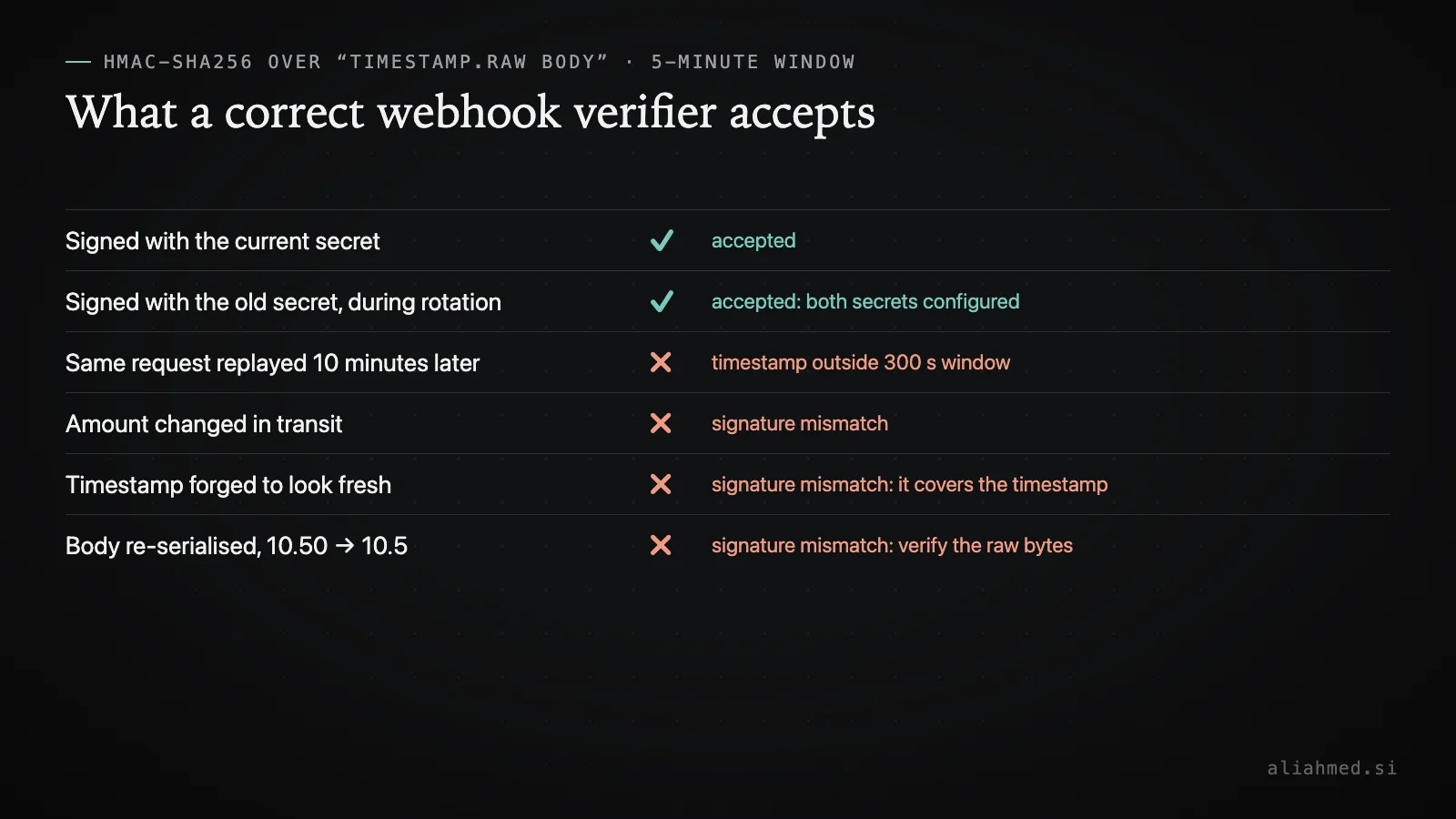
What the verifier below accepts and rejects.
Why each rule matters
| Rule | The attack or bug it stops |
|---|---|
| HMAC over the raw body | Anyone who finds your URL sending fake events |
| Timestamp inside the signature | An attacker changing the timestamp to make an old request look fresh |
| 5-minute window | Replaying a captured valid request hours later |
| Constant-time comparison | Learning the signature byte by byte from response timing |
| List of secrets | Downtime or rejected events while you rotate a leaked or expiring secret |
A signature only proves a request came from the provider. It doesn’t stop the provider from sending the same event twice, so make the handler idempotent as well.
The verifier
import { createHmac, timingSafeEqual } from "node:crypto";

/** Sign as many providers do: HMAC-SHA256 over "<timestamp>.<raw body>", sent with the timestamp. */
export function sign(rawBody, secret, timestamp) {
  return createHmac("sha256", secret).update(`${timestamp}.${rawBody}`).digest("hex");
}

/** secrets is a list so you can rotate: accept the new secret and the old one for a while. */
export function verifyWebhook({ rawBody, timestamp, signature }, secrets, { now = Date.now(), toleranceSec = 300 } = {}) {
  const ts = Number(timestamp);
  if (!Number.isInteger(ts)) return { ok: false, reason: "missing or malformed timestamp" };
  const age = Math.floor(now / 1000) - ts;
  if (Math.abs(age) > toleranceSec) return { ok: false, reason: `timestamp outside ${toleranceSec}s tolerance (age ${age}s)` };
  const given = Buffer.from(String(signature ?? ""), "hex");
  for (const secret of secrets) {
    const expected = Buffer.from(sign(rawBody, secret, ts), "hex");
    if (given.length === expected.length && timingSafeEqual(given, expected)) return { ok: true };
  }
  return { ok: false, reason: "signature mismatch" };
}
The window is checked in both directions: a timestamp far in the future is as suspicious as one in the past, and allowing a little skew covers clocks that disagree by seconds.
Getting the raw body
export async function readRawBody(req, limit = 1_000_000) {
  let size = 0;
  const chunks = [];
  for await (const chunk of req) {
    size += chunk.length;
    if (size > limit) throw new Error("body too large");
    chunks.push(chunk);
  }
  return Buffer.concat(chunks).toString("utf8");
}
With plain node:http, read the body yourself as above. Frameworks usually parse JSON before your handler runs; use their raw-body option for the webhook route (for example, Express’s express.raw({ type: "application/json" }) on that route only), verify, and only then JSON.parse.
The tests
const body = '{"event":"call.ended","id":"evt_1","amount":10.50}';
const good = { rawBody: body, timestamp: String(t), signature: sign(body, "new-secret", t) };

assert.deepEqual(verifyWebhook(good, ["new-secret"], { now }), { ok: true });
// Rotation: the old secret still works while both are configured.
assert.deepEqual(verifyWebhook({ ...good, signature: sign(body, "old-secret", t) }, ["new-secret", "old-secret"], { now }), { ok: true });
// A captured request replayed 10 minutes later.
assert.match(verifyWebhook(good, ["new-secret"], { now: now + 600_000 }).reason, /outside 300s/);
// A forged fresh timestamp: the signature covers it.
assert.equal(verifyWebhook({ ...good, timestamp: String(t + 60) }, ["new-secret"], { now: now + 60_000 }).reason, "signature mismatch");
// Re-serialised JSON: 10.50 becomes 10.5, and the signature no longer matches.
assert.equal(verifyWebhook({ ...good, rawBody: JSON.stringify(JSON.parse(body)) }, ["new-secret"], { now }).ok, false);
All pass on Node.js 24, along with a tampered amount, a malformed timestamp, a missing signature, and an end-to-end check through a real HTTP server that returns 200 for a signed request and 401 for a bad one.
Rotating a secret
- Generate the new secret in the provider’s dashboard, if it supports two active secrets, and add it to your list first.
- Switch the provider to sign with the new secret.
- After the provider’s retry period has passed, remove the old secret.
Keep secrets in environment variables or a secret manager, never in code, logs or an AI agent’s prompt; see securing a voice AI agent’s webhook and where environment variables go.
Summary
- Verify an HMAC over the timestamp and the raw body, not re-serialised JSON.
- Reject requests outside a 5-minute window, in both directions, to stop replays.
- Compare in constant time, after checking lengths.
- Accept a list of secrets so rotation needs no downtime.
- Signatures prove the sender; idempotency handles duplicates.
Related: voice AI agent tool calls and JWT verification pitfalls.
For Vapi’s server URL specifically (X-Vapi-Secret, Bearer and HMAC credentials), see verifying Vapi webhooks in Node.js.
Part of the guide Reliable backends in Node.js and Python, which puts related articles in reading order.