Passive authentication for e-passports in Python: checking data group hashes and the SOD signature
How a KYC app proves a passport chip's data is genuine: hash every data group, compare with the Document Security Object, check its messageDigest, verify the signature and chain the Document Signer certificate to the country's CSCA. Tested Python against a synthetic passport, with the forgery each check catches and the SET-vs-[0] tag bug that rejects genuine passports.
Reading an e-passport chip proves nothing on its own: anyone can write data to an NFC chip. Passive authentication is the check that the data is exactly what the issuing country signed. It has four steps: hash each data group you read (DG1 holds the MRZ, DG2 the photo) and compare with the hash list in the Document Security Object (SOD); check that the SOD’s messageDigest attribute matches that hash list; verify the signature over the signed attributes with the Document Signer (DS) certificate; and check that the DS certificate was issued by the country’s CSCA, which you get from a trusted list, never from the chip. Below is tested Python that runs all four against a synthetic passport. Each forgery step an attacker could try fails a different check, and one subtle bug, verifying the signature over the attributes as they’re stored instead of re-tagged as a SET, makes genuine passports fail.
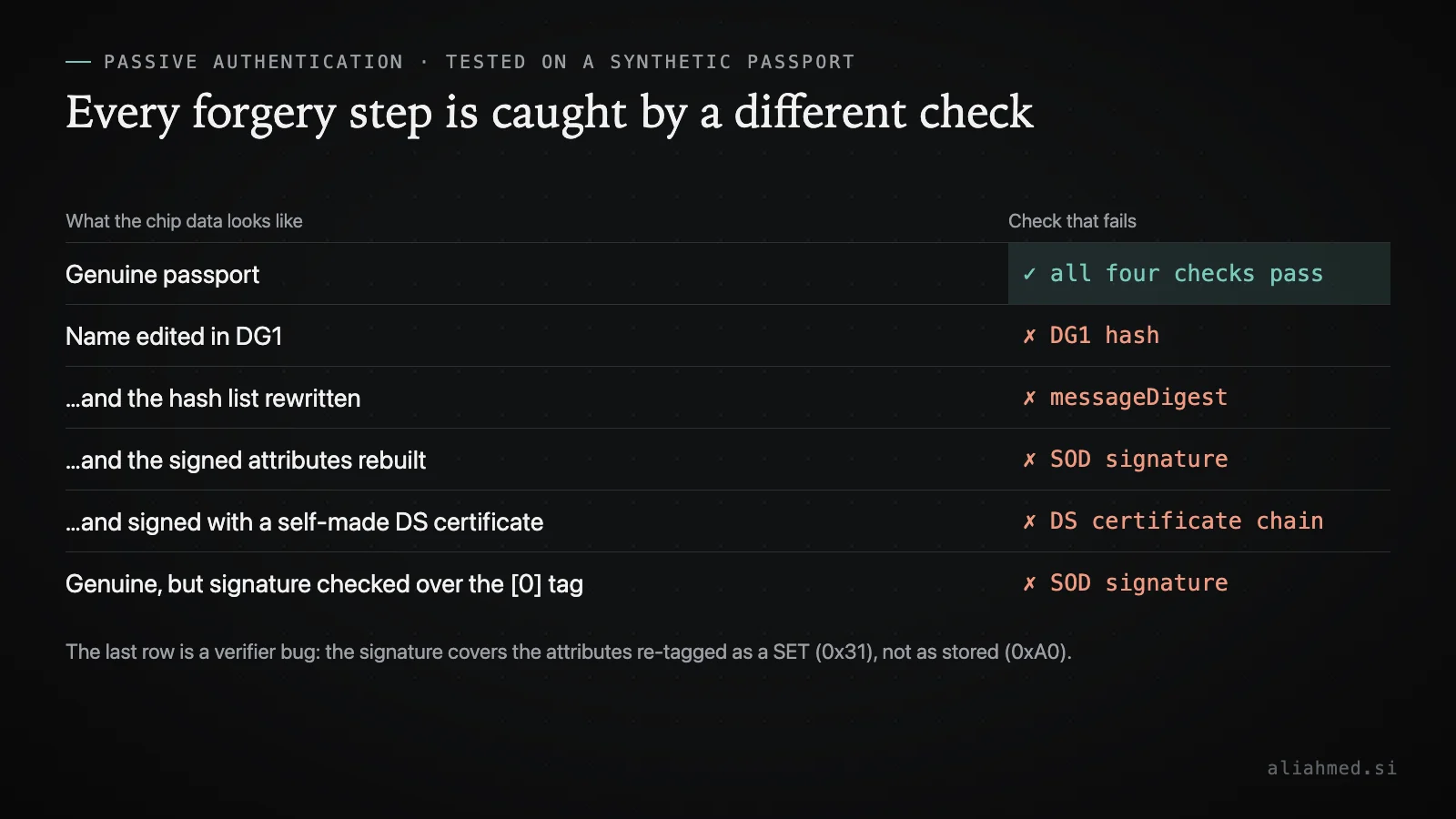
Each layer of a forgery is stopped by the next check down, and the last row is a verifier bug, not an attack.
What’s on the chip?
| File | Contents | What passive authentication does with it |
|---|---|---|
| DG1 | The MRZ, as tag 61 wrapping tag 5F1F | Hash it, compare with the SOD |
| DG2 | The face image (tag 75) | Hash it, compare with the SOD |
| DG14 | Chip authentication keys (when present) | Hash it; used later for chip authentication |
| EF.SOD | Hashes of the data groups, signed by the DS key | Verify the signature and the certificate |
The SOD is a CMS SignedData structure (RFC 5652). Its content is an LDSSecurityObject (OID 2.23.136.1.1.1): a version, a hash algorithm and a list of (data group number, hash) pairs. Reading the files requires unlocking the chip first, with keys from the MRZ: see deriving the BAC keys.
The four checks
import hashlib
from cryptography.exceptions import InvalidSignature
from cryptography.hazmat.primitives import hashes
from cryptography.hazmat.primitives.asymmetric import ec

def passive_authentication(data_groups, lds, signed_attrs, signature, ds_cert, csca_certs, retag=True) -> list[str]:
    """Return the failed checks; an empty list means the data is genuine and unaltered."""
    failures = []
    expected = lds_hashes(lds)                                   # 1. data group hashes
    for n, dg in data_groups.items():
        if expected.get(n) != hashlib.sha256(dg).digest():
            failures.append(f"DG{n} hash")
    if message_digest(signed_attrs) != hashlib.sha256(lds).digest():  # 2. messageDigest
        failures.append("messageDigest")
    signed_bytes = (b"\x31" + signed_attrs[1:]) if retag else signed_attrs  # 3. signature, over a SET
    try:
        ds_cert.public_key().verify(signature, signed_bytes, ec.ECDSA(hashes.SHA256()))
    except InvalidSignature:
        failures.append("SOD signature")
    if not any(_issued_by(ds_cert, csca) for csca in csca_certs):  # 4. chain to a trusted CSCA
        failures.append("DS certificate chain")
    return failures

def _issued_by(cert, issuer) -> bool:
    try:
        cert.verify_directly_issued_by(issuer)
        return True
    except (ValueError, InvalidSignature, TypeError):
        return False
lds_hashes and message_digest are small DER readers (about 25 lines together, in the test file). In production, parse the SOD with a library that handles every variant (RSA, RSA-PSS and ECDSA signatures; SHA-1 to SHA-512 hashes): pymrtd in Python or JMRTD on Android. The checks themselves stay the same.
Does each check catch something?
The test builds a synthetic country: a CSCA certificate, a DS certificate issued by it, and a passport whose DG1 holds the ICAO specimen MRZ. Then it plays the attacker, one step at a time:
dgs = {1: dg1(MRZ), 2: b"\x75" + b"\x00" * 64}  # DG2 stand-in for the photo
lds = lds_security_object(dgs)
attrs = signed_attributes(lds)
sig = sign(attrs, ds_key)
assert passive_authentication(dgs, lds, attrs, sig, ds, [csca]) == []

edited = {**dgs, 1: dg1(MRZ.replace("ERIKSSON", "ERIKSSAN"))}
assert passive_authentication(edited, lds, attrs, sig, ds, [csca]) == ["DG1 hash"]

lds2 = lds_security_object(edited)                     # attacker rewrites the hash list
assert passive_authentication(edited, lds2, attrs, sig, ds, [csca]) == ["messageDigest"]

attrs2 = signed_attributes(lds2)                       # ...and the signed attributes
assert passive_authentication(edited, lds2, attrs2, sig, ds, [csca]) == ["SOD signature"]

fake_ds = cert("DS Utopia", "CSCA Utopia", fake_key, fake_key, False)  # ...and signs with their own key
assert passive_authentication(edited, lds2, attrs2, sign(attrs2, fake_key), fake_ds, [csca]) == ["DS certificate chain"]
Every step fails exactly one check, and it’s always the next layer down. The attacker can recompute any hash, but at the bottom there’s a signature only the country’s key can make, and a certificate only the country’s CSCA can issue. Note the fake DS certificate uses the same names as the real one: matching subject and issuer names proves nothing, only the signature on the certificate does.
Why do genuine passports fail the signature check?
The last row of the figure is the bug I’d expect most first implementations to hit. In the SOD, the signed attributes are stored with the context tag [0] (byte 0xA0). But RFC 5652 says the signature is computed over the attributes encoded as a SET OF (byte 0x31). The content is identical, only the first byte differs, and that’s enough:
passive_authentication(dgs, lds, attrs, sig, ds, [csca], retag=False)  # verify over the stored bytes
# ['SOD signature']   <- a genuine passport, rejected
So if every passport fails at the signature step, check the tag before you check anything else.
Where does the CSCA certificate come from?
Never from the chip. The SOD carries the DS certificate, which is fine, because the chain check verifies it. The CSCA at the top of the chain has to come from a source you trust: the ICAO Public Key Directory (PKD), or master lists that countries publish (signed lists of the CSCA certificates they’ve checked). Trusting a CSCA that arrives with the document would let an attacker bring their own root, which is exactly the last forgery in the test.
Two more things a production verifier needs:
- Validity and revocation. The DS certificate must have been valid when the passport was signed, and not revoked. Countries publish CRLs through the PKD.
- Hash every data group you use. If your app reads DG2 for the face match, its hash must be checked too. A genuine DG1 next to a swapped photo is the classic attack.
What passive authentication doesn’t prove
It proves the data is genuine. It doesn’t prove the chip is: a perfect copy of the files onto another chip passes every check above. Stopping clones needs chip authentication or active authentication, where the chip proves it holds a private key that never leaves it. See how NFC passport verification works for the whole flow, and OCR vs NFC chip verification for what each method can and can’t catch.
Summary
- Passive authentication is four checks: data group hashes, messageDigest, SOD signature, DS certificate chain to a trusted CSCA.
- In the test, each forgery step failed exactly one check: edited DG1, rewritten hashes, rebuilt attributes, self-made DS certificate.
- Verify the signature over the signed attributes re-tagged as a SET (0x31), not as stored (0xA0), or genuine passports fail.
- Get CSCA certificates from the ICAO PKD or master lists, never from the chip.
- It proves the data is genuine, not the chip: add chip or active authentication against clones.
The parsed MRZ fields come from parsing a passport MRZ in Python. For the whole KYC flow, see how KYC identity verification works.
Part of the guide KYC and identity verification engineering, which puts related articles in reading order.