Detecting duplicate companies by website domain and name: what the keys catch, and a Wix-shaped bug
How a lead-research pipeline flags likely duplicate companies for review: normalise names (legal suffixes, accents, '&'), compare word overlap, and match registrable domains with the public suffix list. Tested on real-looking exhibitor names, including the bug where every Wix, Blogspot and GitHub Pages site collapses to one domain, and the plural that word overlap misses.
The same company shows up in a lead list many times: “Siemens Energy L.L.C.” in one listing, “SIEMENS ENERGY LLC” in another, a different stand number next year. Two keys catch most of them: a normalised name (lower case, accents removed, & turned into “and”, and legal suffixes like LLC, FZE, PJSC or GmbH dropped from the end) compared by word overlap, and the website’s registrable domain (shop.example.co.uk and example.co.uk are the same business), found with the public suffix list. A likely duplicate should be flagged for a person with a reason, never merged automatically. Testing the keys from a pipeline I built turned up two problems. With allowPrivateDomains: false, every site hosted on Wix, Blogspot or GitHub Pages collapses to the same domain (wixsite.com), so unrelated companies get flagged as duplicates. And word overlap scores “Gulf Valve Co.” against “Gulf Valves Company” at only 0.33, because “valve” and “valves” are different words.
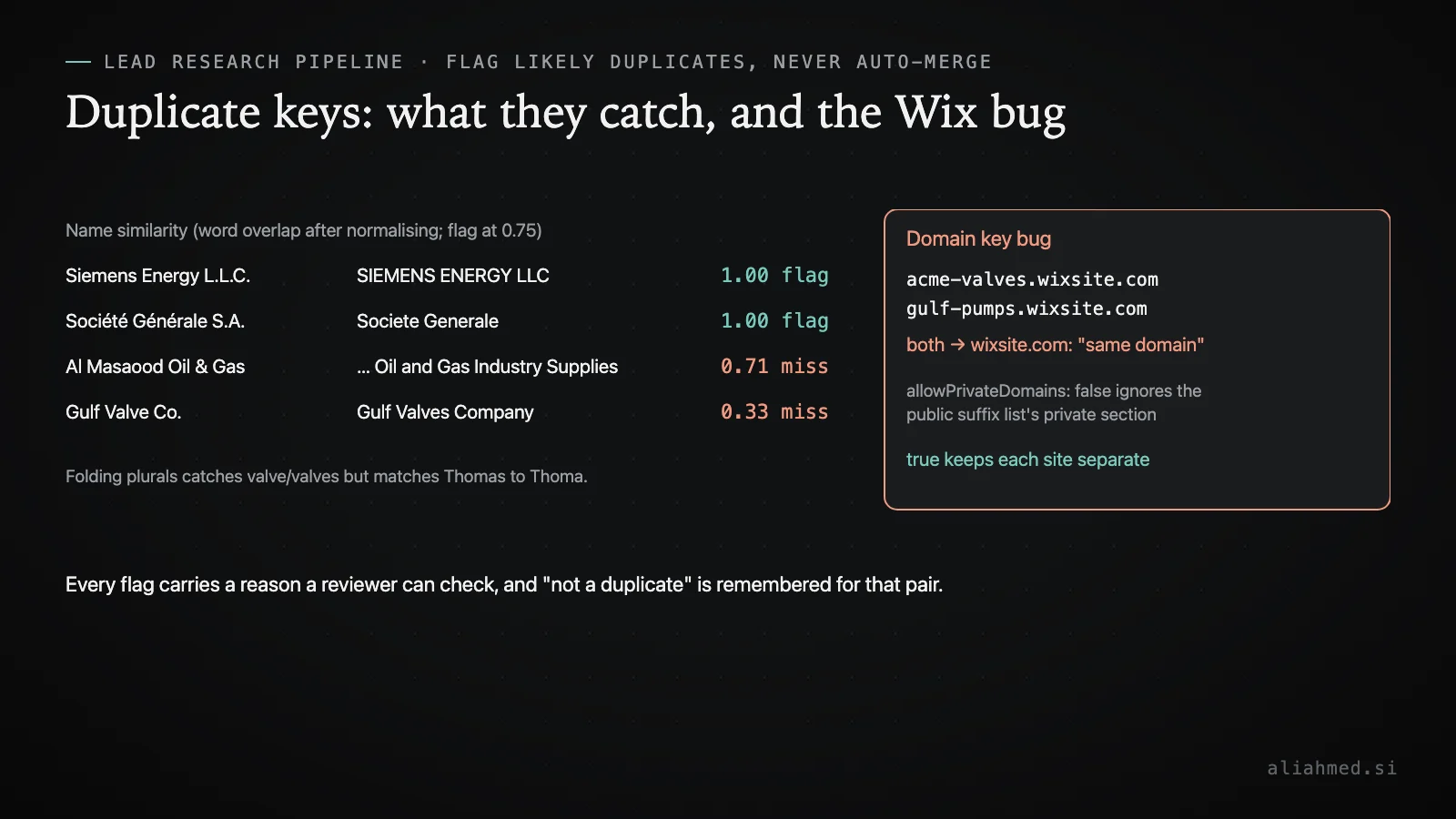
Both keys are useful, and both have failure modes you only see with real data.
The pipeline researches exhibitors at ADIPEC, an energy exhibition with thousands of companies. The code below is ported from it and tested on its own.
Normalising names
const SUFFIXES = new Set(
  (
    "llc fze fzco fz fzc fzllc dmcc ltd limited inc incorporated corp corporation co company pjsc psc plc gmbh ag sa spa srl " +
    "bv nv wll llp lp pte pvt private sdn bhd kk as asa ab oy sas sarl est establishment"
  ).split(" ")
);

export function normalizeName(raw) {
  const base = String(raw)
    .replace(/\s+/g, " ")
    .trim()
    .normalize("NFKD")
    .replace(/\p{M}/gu, "")
    .toLowerCase()
    .replace(/&/g, " and ")
    .replace(/(?<=\b\p{L})\.(?=\p{L}\b)/gu, "")
    .replace(/[^\p{L}\p{N}]+/gu, " ")
    .trim();
  const words = base.split(" ").filter(Boolean);
  if (words[0] === "the" && words.length > 1) words.shift();
  while (words.length > 1 && SUFFIXES.has(words.at(-1))) words.pop();
  return words.join(" ");
}

export function nameSimilarity(a, b) {
  const A = new Set(normalizeName(a).split(" ")),
    B = new Set(normalizeName(b).split(" "));
  const shared = [...A].filter((w) => B.has(w)).length;
  return shared / new Set([...A, ...B]).size || 0;
}
Suffixes are removed only from the end, and only while at least one word remains: “AS” is a Norwegian legal form, but a company called “AS” stays “as”. The dot rule turns “L.L.C.” into “llc” and “S.p.A.” into “spa” before punctuation is stripped, so they can be dropped as suffixes.
What the name key catches
| Pair | Similarity | Result |
|---|---|---|
| Siemens Energy L.L.C. / SIEMENS ENERGY LLC | 1.00 | flagged |
| The Weir Group PLC / Weir Group | 1.00 | flagged |
| Société Générale S.A. / Societe Generale | 1.00 | flagged |
| Smith & Sons / Smith and Sons | 1.00 | flagged |
| Al Masaood Oil & Gas / … Oil and Gas Industry Supplies | 0.71 | missed (threshold 0.75) |
| ADNOC Drilling / ADNOC Distribution | 0.33 | correctly not flagged |
| Emerson Automation Solutions / Emerson | 0.33 | not flagged: a division or the parent? |
| Gulf Valve Co. / Gulf Valves Company | 0.33 | missed: plural |
Folding plurals (drop a final “s” on words longer than four letters, but not “ss”) fixes the valve case, 0.33 → 1.00, and “Emirates Pumps” vs “Emirates Pump” the same. It also matches “Thomas Engineering” to “Thoma Engineering”, 0.33 → 1.00, two different names. For a review queue that trade is fine; for automatic merging it wouldn’t be.
The domain key and the Wix bug
import { getDomain } from "tldts";

export function normalizeDomain(raw, { allowPrivateDomains = false } = {}) {
  try {
    const u = new URL(/^https?:\/\//i.test(raw) ? raw : `https://${raw}`);
    return getDomain(u.hostname, { allowPrivateDomains }) ?? undefined;
  } catch {
    return undefined;
  }
}
https://www.shop.example.co.uk/about  -> example.co.uk   | with private suffixes: example.co.uk
acme-valves.wixsite.com/home          -> wixsite.com     | with private suffixes: acme-valves.wixsite.com
gulf-pumps.wixsite.com                -> wixsite.com     | with private suffixes: gulf-pumps.wixsite.com
acme.blogspot.com                     -> blogspot.com    | with private suffixes: acme.blogspot.com
deltaoil.github.io                    -> github.io       | with private suffixes: deltaoil.github.io
10.0.0.5                              -> undefined
The public suffix list has two sections. The ICANN section knows that co.uk is a suffix; the private section knows that wixsite.com, blogspot.com and github.io are too, because each subdomain belongs to a different customer. With allowPrivateDomains: false the library ignores the private section, and every small business on Wix gets the domain wixsite.com. Small companies often use site builders like these, and any two of them would be flagged as having the “same website domain”. Setting it to true fixes it.
Flag, don’t merge
- Every flag carries a reason a reviewer can check: “Same website domain (example.co.uk) as Gulf Valve Co.” or “Near-identical name”.
- “Not a duplicate” is remembered for that pair, so the same flag doesn’t come back after the next refresh.
- Merging is a person’s decision. A wrong automatic merge loses data; a wrong flag costs a click.
Summary
- Normalise names: accents,
&, legal suffixes at the end, “the” at the start; compare by word overlap and flag at a threshold. - Match websites by registrable domain, and use the public suffix list’s private section too: without it, every Wix and Blogspot site looks like the same company.
- Word overlap misses plurals; folding them helps but also matches Thomas and Thoma.
- Flag with a reason, remember “not a duplicate”, never auto-merge.
For the same pipeline’s rule that a person’s correction always beats the scraper, see keeping scrapers from overwriting human edits. Matching people’s names is harder still: see fuzzy name matching for sanctions screening.
Part of the guide Reliable backends in Node.js, Python and Go, which puts related articles in reading order.