Parsing partial JSON from a streaming LLM: show structured output while it's still being written
When an LLM streams JSON, every intermediate chunk is invalid JSON. A small tested JavaScript parser that closes open strings, drops dangling keys and half-written literals, and closes open arrays and objects, so the UI can render fields as they arrive. Every one of 119 prefixes of the test document parsed.
When you ask an LLM for structured output and stream the response, the client receives JSON one fragment at a time: {"title":"Refu, then nd policy","ste, and so on. Every intermediate state is invalid JSON, so JSON.parse fails until the very last token, and the user stares at a spinner. A partial JSON parser fixes that: track which strings, arrays and objects are open, close an open string, drop what can’t be completed yet (a dangling key, a trailing comma, a half-written tru), then append the missing closing brackets and parse. The UI can then render each field as soon as it exists. Below is a tested parser in about 35 lines; on the test document, all 119 prefixes parsed, and no field ever disappeared once it had appeared.
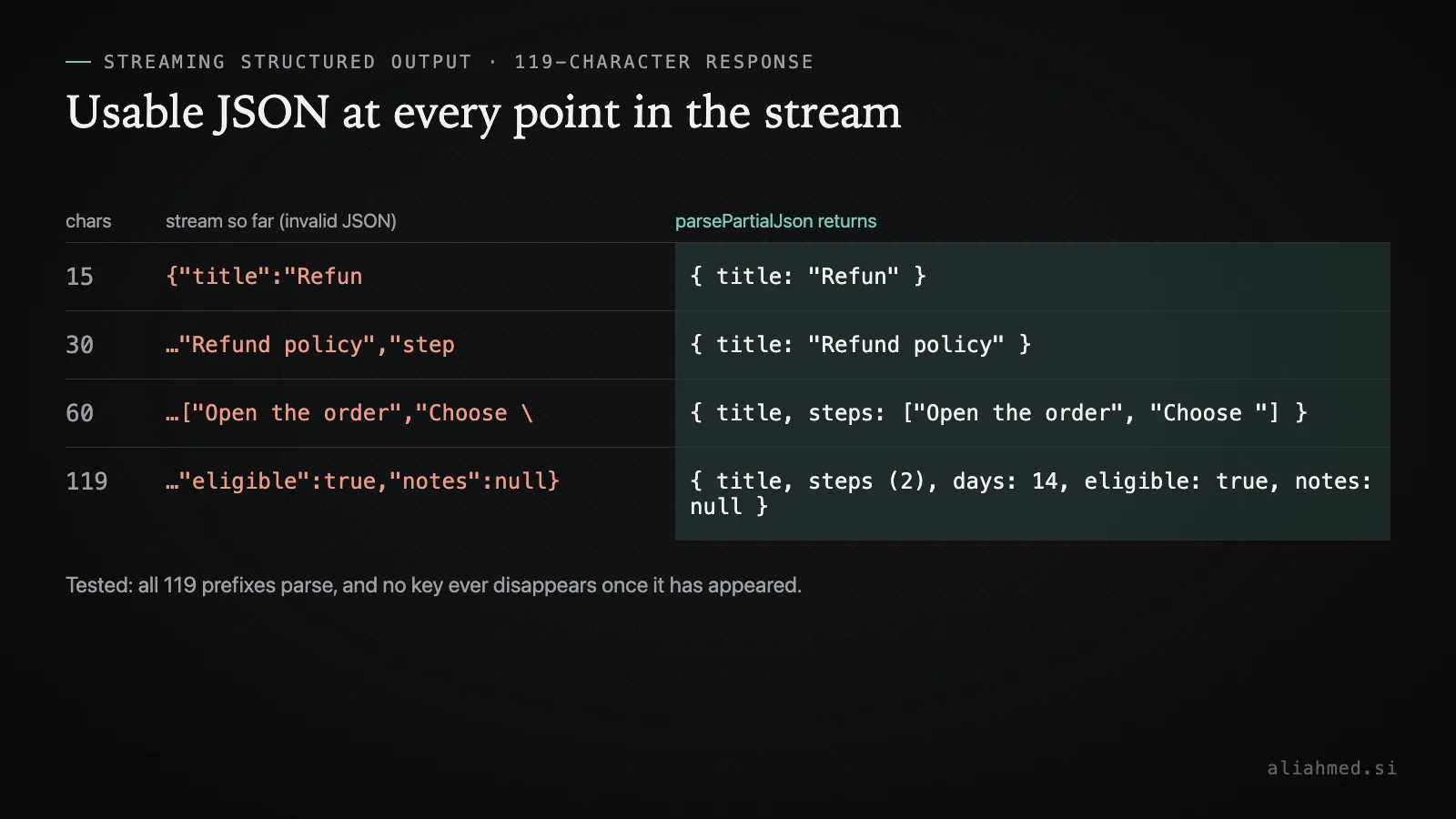
What the parser returns at four points in the stream.
The parser
export function parsePartialJson(text) {
  const stack = [];
  let inString = false;
  let escaped = false;
  for (const ch of text) {
    if (inString) {
      if (escaped) escaped = false;
      else if (ch === "\\") escaped = true;
      else if (ch === '"') inString = false;
    } else if (ch === '"') inString = true;
    else if (ch === "{" || ch === "[") stack.push(ch);
    else if (ch === "}" || ch === "]") stack.pop();
  }
  let fixed = inString ? (escaped ? text.slice(0, -1) : text) + '"' : text;
  const closers = () =>
    [...stack]
      .reverse()
      .map((c) => (c === "{" ? "}" : "]"))
      .join("");
  // Cleanups, applied one at a time until the text parses: each removes one kind of unfinished tail.
  const rules = [
    /[\s,]+$/, // trailing comma or whitespace
    /:\s*(-|t|tr|tru|f|fa|fal|fals|n|nu|nul|-?\d+\.)$/, // half-written literal after a key
    /(?<=[,{])\s*"(?:[^"\\]|\\.)*"\s*:?\s*$/, // dangling key, with or without its colon
    /(?<=[,[])\s*(-|t|tr|tru|f|fa|fal|fals|n|nu|nul|-?\d+\.)$/, // half-written literal in an array
  ];
  for (let guard = 0; guard < 8; guard++) {
    try {
      return JSON.parse(fixed + closers());
    } catch {}
    const before = fixed;
    for (const rule of rules) fixed = fixed.replace(rule, "");
    if (fixed === before) break;
  }
  return undefined;
}
The scan tracks one thing that’s easy to get wrong: escaped quotes. "say \"hi is still inside a string, and the parser must not treat the escaped quote as its end. If the text stops right after a backslash, the parser drops that backslash before closing the string; otherwise the closing quote would itself be escaped.
What did testing catch?
My first version applied the cleanups in a fixed order: drop the dangling key, then the half-written literal. On {"days":14,"eligible":tr that does nothing useful, because "eligible" isn’t dangling until tr is gone. It returned nothing instead of { days: 14 }. The fix is the loop: try to parse, apply every cleanup once, try again, so the order no longer matters.
assert.deepEqual(parsePartialJson('{"title":"Refu'), { title: "Refu" });
assert.deepEqual(parsePartialJson('{"title":"Refund","ste'), { title: "Refund" });
assert.deepEqual(parsePartialJson('{"title":"Refund","steps":["Open'), { title: "Refund", steps: ["Open"] });
assert.deepEqual(parsePartialJson('{"days":14,"eligible":tr'), { days: 14 });
assert.deepEqual(parsePartialJson('{"q":"say \\"hi'), { q: 'say "hi' });
assert.deepEqual(parsePartialJson('{"q":"a\\'), { q: "a" }); // stream cut mid-escape
The main test feeds every prefix of a 119-character document, with a nested array, an escaped quote, a number, true and null. All 119 parse, the last equals JSON.parse of the full text, and no key present in one prefix is missing from the next.
Using it in a UI
- Render only what’s stable. A string value grows as it streams (
"Refu", then"Refund policy"), which is fine for text. For values that trigger actions, such as an ID or an enum, wait until the field is complete: when a later key appears, the earlier one is finished. - Validate the final object, not the partial ones. Run the schema check once the stream ends, as in getting reliable JSON from LLMs.
- Parse the stream first. The text you pass in is the concatenated content deltas from the event stream; reading those correctly is covered in parsing a streamed LLM response.
- Throttle re-parsing. Re-parsing the whole text on every token is O(n²) over the response. For long documents, parse every few tokens or on an animation frame.
Summary
- Streaming JSON is invalid until the end; a partial parser makes it usable as it arrives.
- Track open strings and brackets, close the string, drop unfinished tails, close the brackets, parse.
- Apply cleanups in a loop rather than a fixed order: the tests showed a fixed order fails.
- Render text fields as they grow, act on a field only when the next key appears, and validate the final object.
Related: cancel the LLM call when the client disconnects.
Part of the guide Production LLM engineering, which puts related articles in reading order.