Guardrails for LLM-written sales emails: cited facts, banned claims, and what regex checks miss
How a lead-research pipeline keeps an LLM from inventing meetings, relationships and numbers in outreach drafts: numbered facts the model must cite, banned-claim patterns, a number check, a hedged hypothesis, one retry with the reasons, then 'insufficient evidence'. Tested against 12 sentences: 7 caught, 5 missed, including a number bug where 3.5 million passed because a fact said 35.
When an LLM drafts sales emails from scraped company data, the dangerous mistakes aren’t typos: they’re claims that aren’t true. “Great meeting you at the expo”, “as discussed”, “our existing partnership”, “you grew 40% last year”. In a lead-research pipeline I built, the model sees only numbered facts from the company’s own website (F1, F2…) and must return the IDs it relied on; then code checks every draft for banned claims (meetings, earlier conversations, relationships, shown interest), numbers that aren’t in the facts, at least one real citation, and a hypothesis written as a possibility rather than a fact. A failing draft gets one retry with the reasons; if it fails again, it’s saved as “insufficient evidence”, not sent to a person to approve. I tested those checks against 12 sentences: they caught all 7 obvious violations and missed 5 paraphrases, including a real bug where “3.5 million customers” passed because a fact said “35 engineers”.
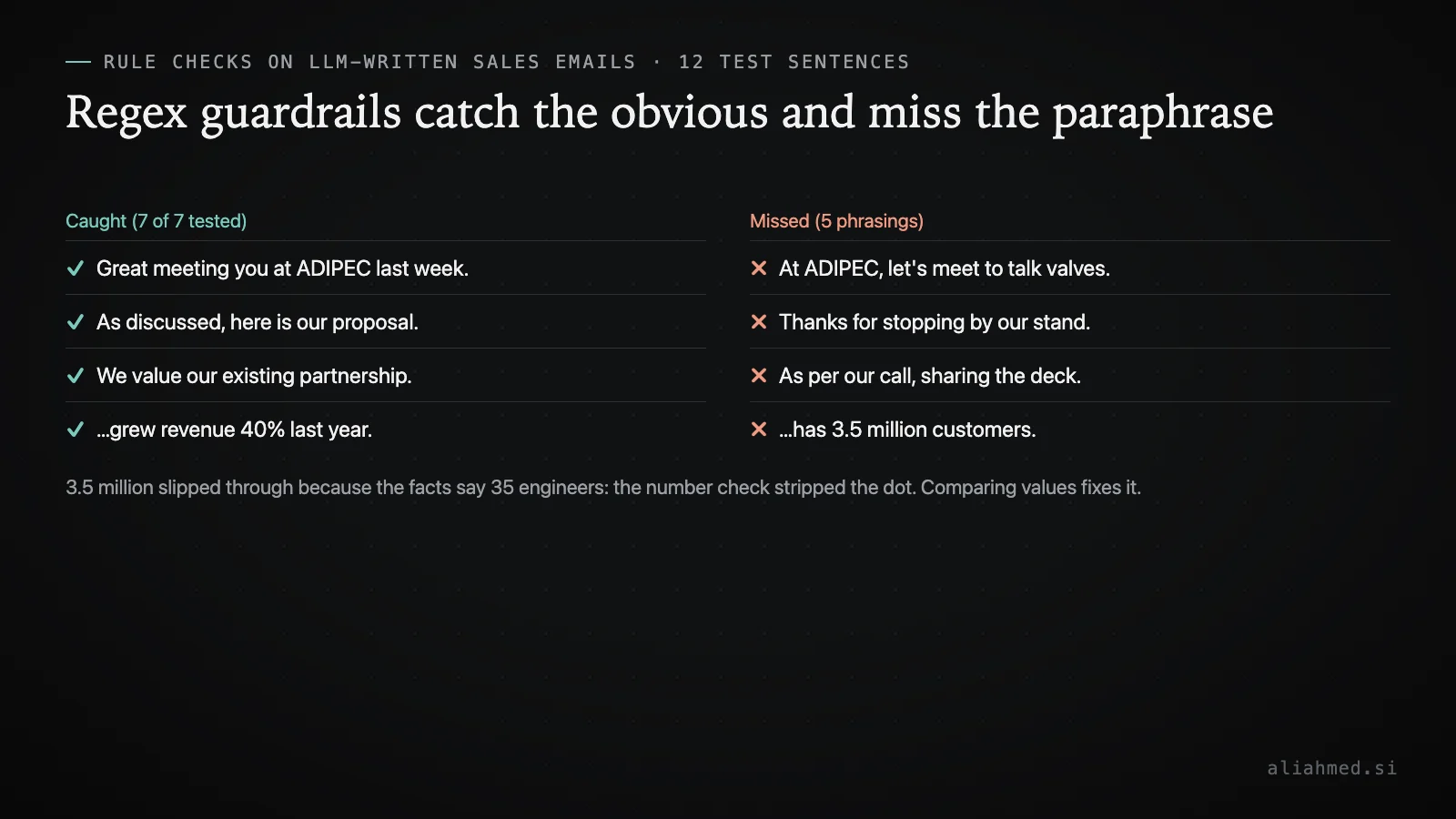
Pattern checks are a floor, not a guarantee: they catch the phrasings you thought of.
The pipeline researches exhibitors at ADIPEC, an energy exhibition, and drafts first-contact emails for a sales team to review. Nobody on the team has met these companies, so any hint of an earlier meeting is a lie the model invented.
How does a draft get from facts to a sent email?
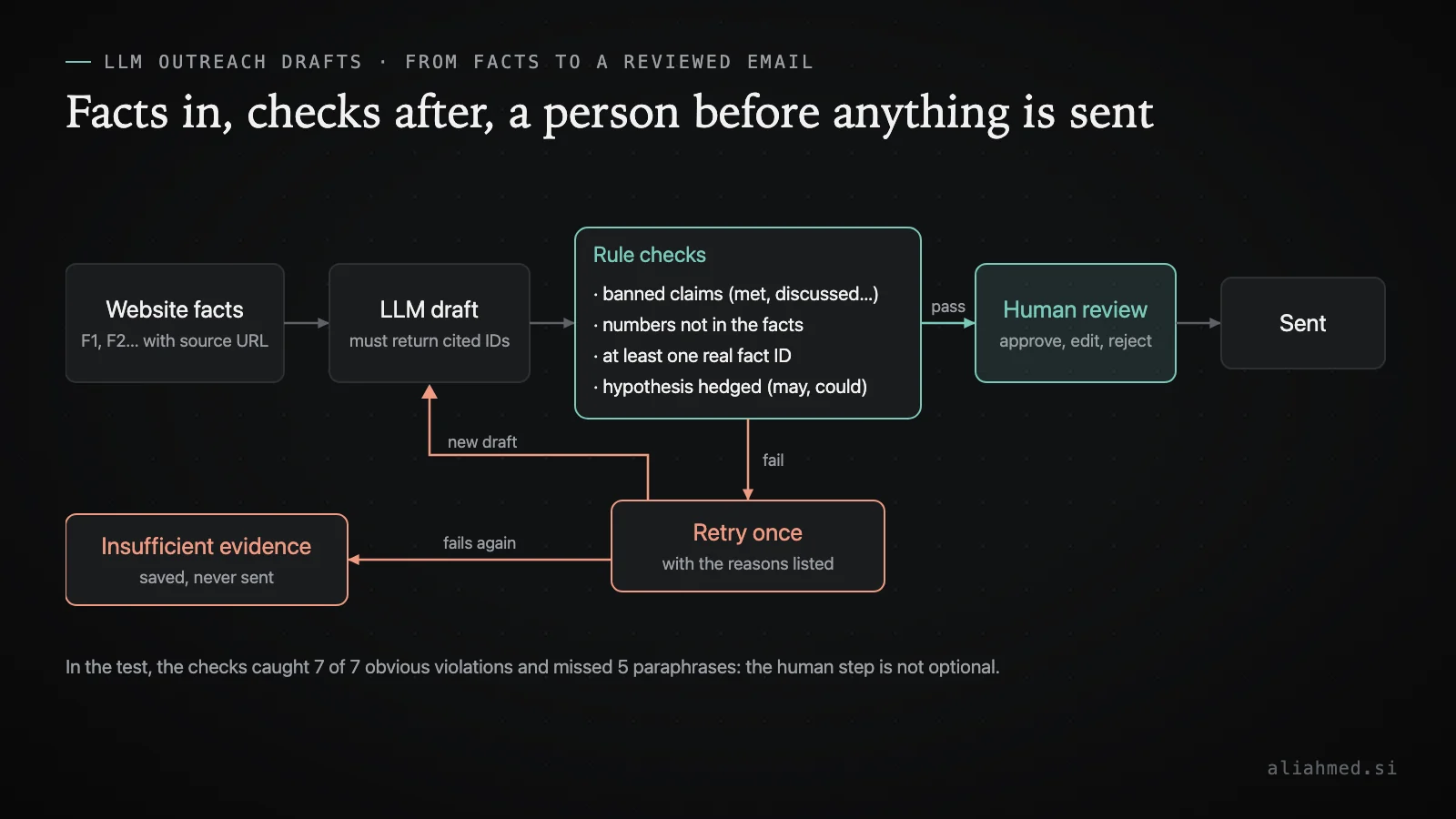
The checks sit between the model and a person, never between the model and the recipient.
How is the prompt set up?
The model gets only what the code collected, each fact with an ID and its source page:
{
  "company": "Gulf Valve Co.",
  "facts": [
    { "id": "F1", "text": "Gulf Valve Co. has supplied pipeline valves since 1998.", "url": "https://example.com/about" },
    { "id": "F2", "text": "The company employs 35 engineers in Abu Dhabi.", "url": "https://example.com/team" }
  ]
}
The system prompt says to use only these facts, never to claim a meeting, earlier conversation, relationship or interest, never to add numbers that aren’t in the facts, and to return citedFactIds. The source link shown to reviewers always comes from the stored fact, never from the model, so the model can’t invent a source.
The checks
export const BANNED = [
  [/\b(met|meet|meeting|spoke|speaking|chatted|see you|catch up)\b[^.]{0,40}\badipec\b/i, "claims a meeting at ADIPEC"],
  [/\badipec\b[^.]{0,40}\b(met|meeting|spoke|conversation|chat)\b/i, "claims a meeting at ADIPEC"],
  [
    /\b(as (we )?discussed|following (up on )?our (call|conversation|chat|meeting)|great (to|meeting) (meet|you|speak))/i,
    "claims an earlier conversation",
  ],
  [/\bour (existing |ongoing |long-standing )?(partnership|collaboration|relationship)\b/i, "claims an existing relationship"],
  [/\byou(r team)? (expressed|showed|shared|mentioned) (an )?interest\b/i, "claims they showed interest"],
];

const NUMBER = /\d(?:[\d,.]*\d)?/g;
const digitsOnly = (n) => n.replace(/[,.]/g, "");

export function checkDraft(texts, cited, pack, { hypothesis, known = "", numbers = "original" } = {}) {
  const problems = new Set();
  for (const t of texts) for (const [re, why] of BANNED) if (re.test(t)) problems.add(why);
  const norm = numbers === "fixed" ? toValue : digitsOnly;
  const knownSet = new Set((`${known} ${pack.map((f) => f.text).join(" ")}`.match(NUMBER) ?? []).map(norm));
  const invented = texts.flatMap((t) => t.match(NUMBER) ?? []).filter((n) => !knownSet.has(norm(n)));
  if (invented.length) problems.add(`uses numbers that aren't in the facts (${[...new Set(invented)].join(", ")})`);
  const ids = new Set(pack.map((f) => f.id));
  if (!cited.some((c) => ids.has(c))) problems.add("cites none of the provided facts");
  if (hypothesis !== undefined && !/\b(may|might|could|possibly|perhaps|likely)\b/i.test(hypothesis)) problems.add("states the hypothesis as a fact");
  return [...problems];
}
A draft with problems goes back to the model once, with the problems listed (“Your previous answer broke these rules: claims an earlier conversation. Write it again following every rule.”). A second failure stops there.
What the tests show
Five tests, 12 sentences. Caught, each with the reason the reviewer would see:
- “Great meeting you at ADIPEC last week.” → claims a meeting at ADIPEC; claims an earlier conversation
- “See you at ADIPEC!” → claims a meeting at ADIPEC
- “As discussed, here is our proposal.” and “Following up on our call about valves.” → claims an earlier conversation
- “We value our existing partnership.” → claims an existing relationship
- “Your team showed interest in automation.” → claims they showed interest
- “…grew revenue 40% last year.” → uses numbers that aren’t in the facts (40)
Missed, all passing every check:
- “At ADIPEC, let’s meet to talk valves.” The second pattern has “meeting” but not “meet”.
- “Thanks for stopping by our stand.” Implies a visit with none of the keywords.
- “As per our call, sharing the deck.” “As per” isn’t “as discussed”.
- “You were interested in predictive maintenance.” “Were interested” isn’t “showed interest”.
- “Gulf Valve Co. has 3.5 million customers.” A bug, not a phrasing gap.
The number bug
The number check removes commas and dots so that “1,200” in a draft matches “1200” in a fact. But it also turns “3.5” into “35”, and the facts say “35 engineers”, so an invented 3.5 million passes. Comparing values instead fixes it:
// Fixed: "1,200" and "1200" are the same number, but "3.5" and "35" are not.
function toValue(n) {
  const plain = /^\d{1,3}(,\d{3})+(\.\d+)?$/.test(n) ? n.replace(/,/g, "") : n;
  return String(Number(plain.replace(/,/g, ".")));
}
With it, “3.5 million” is flagged, while “1200 square metre” and “1,200 square metre” still match the fact. The test also shows two softer spots: one real citation is enough, even next to an invented ID like F9, and the hypothesis check only looks for a hedge word anywhere, so “They struggle with manual inspections, which may slow audits” passes.
Can you just add more patterns?
For the four missed phrasings, one more pattern each is easy:
const EXTRA = [
  [/\badipec\b[^.]{0,40}\bmeet\b/i, "claims a meeting at ADIPEC"],
  [/\b(stopping|stopped|dropping) by (our|the) (stand|booth)\b/i, "claims a visit"],
  [/\bas per our (call|conversation|chat|meeting)\b/i, "claims an earlier conversation"],
  [/\byou were interested\b/i, "claims they showed interest"],
];
All four misses are caught with them. Then I ran both rule sets over six sentences a good email could contain. The original rules flagged 0 of 6; the extended rules flagged 1 of 6: “If you’re at ADIPEC, we’d be glad to meet there or online”, an honest invitation, now reads as “claims a meeting at ADIPEC”. That’s the pattern treadmill: every rule that catches a paraphrase also catches something legitimate that happens to use the same words. Keep adding rules for misses you see in real drafts, keep a list of legitimate sentences in the tests so you notice false positives, and let the reviewer decide the borderline cases.
So what should the checks be?
- Keep the regexes, and add every miss you find to a test file. They’re cheap, fast and explainable to the reviewer.
- Fix numbers by value, as above, and treat units (“million”, ”%”) as part of the match if you need to be stricter.
- Add a second model as a judge for the claim categories, asking one narrow question per category (“Does this text say or imply the sender has met or spoken to the recipient? yes/no”). Measure the judge against labelled examples before trusting it; LLM judge agreement with Cohen’s kappa shows how.
- Keep a person in the loop. In this pipeline, drafts are reviewed and approved before anything is sent, and an approved draft never changes unless someone approves again. The checks reduce what reviewers have to catch; they don’t replace them.
- Treat scraped text as untrusted. Website copy can contain instructions aimed at the model: see prompt injection in scraped data.
Summary
- Give the model numbered facts and make it cite IDs; take source links from your data, not the model.
- Check drafts for banned claims, invented numbers, missing citations and an unhedged hypothesis; retry once, then mark insufficient evidence.
- In the test, the checks caught 7 of 7 obvious violations and missed 5 paraphrases.
- Stripping dots in numbers let 3.5 million pass against 35 engineers; compare values.
- Regexes are a floor: add a narrow LLM judge and keep human approval.
The same approach applied to research summaries, where every numeral is traced back to the paper, is in how to stop an LLM from inventing numbers. For validating the structure of model output, see LLM structured output validation.
Part of the guide Production LLM engineering, which puts related articles in reading order.